The Best Laptops of 2021
- Get link
- X
- Other Apps
- What's the best laptop? If we knew that,

PCMag wouldn't have to review more than 100 of them a year.
At PC Labs, we test all kinds. Family laptops, business laptops, cheap ones, expensive ones, gaming rigs, workstations, ultralights, desktop replacements, tablets, Macs, Windows, Chromebooks. Why? Because different users need different things from the laptop. No laptop is right for every person. Our reviews combine hands-on experience and objective performance testing and battery life benchmarks, and plenty of contexts. We aim to show you where the laptop fits on a spectrum of price, performance, portability, and suitability for different tasks. And while one side of the laptop doesn't fit all, we do have some favorites. We'll start with some affordable or economical laptops, one for each of the three popular operating systems. If you think Chromebooks are just cheap laptops for school kids, Acer's Chromebook Spin 713 will change your mind. It's not an impulse buy at over $600, but it is made of aluminum instead of plastic and has a nice Gorilla Glass touchscreen. It's a convertible, so you can flip it, fold the display from an ordinary laptop mode to an easel mode for presentations, or to tablet mode for writing and drawing. The screen is great. It's a high-resolution panel, 3:2 aspect ratio, more of a square instead of the common rectangular 16:9. You can also see more of this content this way without having to scroll. The Spin 713 has a speedy Intel Core i5 processor and a roomy solid-state drive, instead of the small and slow flash memory storage that most Chromebooks come with. It has an HDMI port, so you can plug it into an external monitor without needing an adapter for a USB-C port. Like all convertibles, it's a little heavy if you're using it as a tablet. It's about three pounds, and it doesn't come with a pen or a stylus if that's your kind of thing. But if you do most of your work in Chrome browser, Gmail, Google Docs, which keeps changing its name, it's now called Google Workspace, the Acer Spin 713 is a great productivity partner.
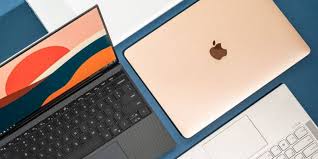
It syncs seamlessly with your Android phone, delivers smooth updates and virus protection, and this has turned a lot of folks into fans of Chromebooks. At $999, the MacBook Air has always been the lowest-priced Apple laptop, but in late 2020, when Apple moved a couple of its MacBooks from the Intel processors to Apple's remarkable M1 processor, the MacBook Air became the best MacBook, period. It's extremely fast, super portable at 2.8 pounds, and it gets incredible battery life. It lasted for 29 hours on our video playback test. If that doesn't close the deal, it's available in three colors: gray, silver, and gold. The 13.3-inch retina display looks fabulous and it has the True Tone technology that adjusts the white balance according to the lighting where you are. The Mac operating system's easy to use and of course offers unbeatable integration with your other Apple stuff, whether that's an iPhone, an iPad, or an Apple Watch. We only have two reservations. One is that Apple still doesn't do touchscreens, so you'll have to use the touchpad only, which fortunately is one of the best in the world on any laptop. The other is that you only get two Thunderbolt ports with USB-C connectors, so you'll need adapters to plug in a monitor or a flash drive, or another device with a rectangular USB port. Otherwise, the MacBook Air is a small laptop that's a big winner. Here's another convertible that can switch
from laptop to tablet mode, or prop up like a tent, while using its touchscreen. That's not the most impressive thing about the Lenovo IdeaPad Flex 5 14, though. The most impressive thing is that it costs only around $600 and it outperforms many systems that cost twice as much. You'll have to shop around for that though. The version we tested keeps going in and out of stock and the price shoots up and down. Now, why is it in such high demand? Give credit to the IdeaPad Flex's AMD 5 Ryzen 4500U, a six-core processor that slugs it out not only with Intel's Core i5 but the higher-end Core i7. The test unit also had a 256-gigabyte solid-state drive, a comfortable keyboard, and plenty of ports. The only real issue is that it supports a slightly older, slower Wi-Fi 5, instead of today's Wi-Fi 6 wireless internet. A more serious complaint is that the 14-inch screen isn't the brightest, though it is all right if you leave the brightness setting turned all the way up. But if you can find this one in stock at Amazon.com, specifically -- and we say that
because some of the retailers charge more money for models with less storage and memory -- the IdeaPad Flex 5 14 is one of the best bargains in Lenovo's lineup. Let's look at one more convertible laptop, our favorite among two-in-ones. The HP Spectre x360 14 is a deluxe notebook that costs $1,700, but it's worth it for the screen alone. It's a 13.5-inch touch panel with a square 3:2 aspect ratio like the Acer Chromebook Spin 713 has, but it has a sharper resolution of 3000 by 2000 pixels. And the screen resolution uses OLED technology like upscale TV sets do. OLED stands for organic light-emitting diode, and it gives you the darkest blacks, the highest contrast, and the most brilliant, vivid colors available. It's just a dazzling display and it comes with a stylus pen for writing and drawing too. The Spectre x360 14 also has a fast 11th generation Tiger Lake Intel Core i7 chip, plenty of storage, and 12 hours of battery life, which is pretty good considering the dazzling screen. And it looks great too. It has a gorgeous aluminum chassis with gem-cut edges, available in silver, black with copper accents, or blue with brass accents. It doesn't have an HDMI port, so it requires a Thunderbolt or USB-C adapter to connect to a monitor, but the display is so nice that you may not need to. This one is a keeper. So, it happens pretty much like clockwork. Dell unveils an updated version of its XPS 13 ultraportable, and then we give it an Editors' Choice Award. Laptops with 13-inch, technically 13.4-inch screens don't come any more compact or easier to carry than the newest XPS 13, and laptops with thinner, borderless displays don't exist. The base model has a handsome 1920 by 1200 pixel touchscreen that gave it 15 hours of battery life in our test. There's also an optional 3.5K display with OLED technology, just like with the HP Spectre x360 14 I was raving about that cuts the runtime down to 11 hours, but it is irresistibly good-looking. The XPS 13 is a premium piece. It starts under $1000 just by a bit, but it's easy to spend upwards of $1700
for a loaded version with a sleek white glass fiber finish. It looks like the MacBook Air, it has a couple of USB-C Thunderbolt ports without an HDMI port for a monitor or a rectangular USB port for an external drive, but it's arguably the gold standard for the under three-pound laptop category, and it can handle almost any job
except for playing serious PC games. If we had to cut our top 10 to a top two, this would be one of them. Laptops built for serious gamers with dedicated graphics processors, instead of the slower integrated graphics built into most processors, range from under $1000 to $3000 or more. The Acer Predator Triton 300 SE is a terrific value at around $1400, and it's also much more portable than most of the gaming notebooks we see. It was just under three and three-quarter pounds instead of five or six, and that's because it has a 14-inch screen instead of the usual 15.6-inch screen. While it looks a little small, especially if you're used to a desktop monitor, it's perfectly playable. The Triton 300 SE combines an Intel Core i7 CPU,
NVIDIA GeForce RTX 3060 graphics, and a reasonable 16 gigabytes of memory and 512 gigabytes of storage. The display has a refresh rate of 144 Hertz, meaning you can show animation at up to 144 frames per second,
instead of generic laptops' 60 frames per second limit. That's solid mid-range or better performance by gaming standards, and depending on the kinds of games you play, you'll definitely see frame rates of 100 FPS or more. You won't be at a disadvantage in a fast-twitch competition at the end of the day. There are faster gaming rigs, I'm about to describe one in a moment,
but they're bigger, heavier, and more expensive than the Predator Triton 300 SE. This makes surprisingly few compromises for its low cost, so it's well worth checking out. Now, if PC gaming is the most important thing in the world to you, you want a cost-no-object, no compromise, 15.6-inch gaming laptop. There are several superb options, especially at the top end of the range, but the latest version of the Razer Blade 15 Advanced Edition stands out as one of the thinnest and the lightest. It's only two-thirds of an inch thick and weighs 4.4 pounds. The Alienware m15 is powerful, also great, and a bit cheaper, but it weighs as much as six pounds. And so, we're suckers for portability. The Razer it is. The Blade 15 we tested was priced at $2899, loaded with an eight-core 10th generation Intel i7 processor, top-of-the-line NVIDIA RTX 3080 in graphics, 32 gigabytes of RAM, and a one terabyte SSD. It also has plenty of ports, a sleek metal chassis with customizable color lighting for every keyboard key, and the best touchpad of any Windows laptop. Best of all is the screen,
which gives you both a higher resolution and a faster 240 Hertz refresh rate than most deluxe gaming rigs. The screen is 2560 by 1440 pixels, instead of the usual 1920 by 1080 of most gaming rigs. You'll see every detail of your game
with blazing smooth animation.
It'll be you taking your enemies by surprise,
instead of the other way around. If you want a super premium gaming laptop, the Razer Blade 15 Advanced is about as good as it gets.
I said if we had to cut our top 10 laptops down to only two, the Dell XPS 13 would be one. The Lenovo ThinkPad X1 Carbon would probably be the other.
It's Dell's slightly bigger screen, slightly more business-focused archrival, and it might just be the finest laptop on the planet.
2021's ninth-generation version makes just evolutionary improvements, but believe me, the X1 Carbon didn't really need revolutionary ones. This is a 14-inch notebook with a tough chassis made of carbon fiber and magnesium alloy. Because of that, it weighs just two and a half pounds. It can be wicked expensive. Our specific test unit cost $2200, with the standard screen instead of the optional higher resolution screen. And the screens use IPS technology that's excellent, but not quite as dazzling as the XPS 13's OLED screen. But it lasted almost 20 hours in our battery test, and you won't find a better keyboard on any laptop of any kind. The ThinkPad's connectivity puts the Dell XPS 13's to shame, though. It has an HDMI monitor port and two rectangular USB ports, as well as two USB-C Thunderbolt ports, plus optional 4G or 5G mobile broadband to stay online when there's no Wi-Fi hotspot around. It's as fast, as powerful, as anything short of a fire-breathing gaming laptop or computer graphics workstation. The ThinkPad X1 Carbon is an aspirational laptop for most of us, but the business execs who can afford it are the lucky folks. What if you don't need an ultraportable or a gaming laptop, can live without a two-in-one convertible, and just want a notebook that's not too big, not too small, and can handle any job you throw at it? Check out the Microsoft Surface Laptop 4.
It's available with both 13 and 15-inch screen sizes,
from processors available from both AMD and Intel. We tested a 15-inch model that cost $1499,
with a strong AMD Ryzen 7 CPU. It weighs 3.4 pounds, lasted almost 14 hours on our battery test, which makes it a good portable laptop overall. Now the keyboard is above average, though it does lack a numeric keypad. A more serious drawback is the Surface is a little short on ports, with just one USB-C and one USB Type-A. There's neither a Thunderbolt nor a dedicated monitor port, which a laptop at this price should really have. But the Surface Laptop 4's ace in the hole is what Microsoft calls its PixelSense screen. It has a square 3:2 aspect ratio, which, as I've mentioned, lets you see more of the webpage or spreadsheet without scrolling, and has a higher resolution of 2469 by 1664 pixels, almost as many as so-called 4K displays. It's a pleasure to look at and this laptop is a pleasure to use.
Finally, let's close out our list by looking ahead. The Asus ZenBook Duo 14 won a PCMag TechX Award for design innovation because it's a compact and attractive system today that could well be an example of a laptop of tomorrow.
It's called the Duo because it has two touchscreens, the main 14-inch display and the ScreenPad Plus, a 12.6-inch panel that tilts upward between that screen and the keyboard. The second screen works like a second monitor. It can show any app you pull down from the main screen, so you can work two documents at once, or lets you keep some reference material or your schedule, any other app that you only need to look at, handy. You can use it as a messaging window, keep Spotify open, anything like that that you might not need to touch actively but want to have open to looking at. The ScreenPad Plus may not be very big, but it's surprisingly convenient, even if you're just using it as a calculator or control panel with commands for Adobe Photoshop or Premiere Pro. And even with the two displays, the ZenBook Duo 14 only weighs three and a half pounds. The compromise is that the ScreenPad Plus pushes the keyboard down to the bottom edge, there's no palm rest, the touchpad is moved to the right edge of the keyboard instead of below it. It's also a bit narrow. That takes some getting used to, but the laptop has plenty of ports, quite good performance, and battery life,
and isn't too expensive at $1300, which might not be what you expected for two screens. If you march to the beat of a different drummer, it's a great way to keep pace.- Get link
- X
- Other Apps


Comments
Post a Comment